
Course structure
The Specialization School in Biosystemic Psychotherapy is a four-year program totaling 2,000 hours, divided as follows: 1,400 hours of theoretical, practical, and experiential training in the classroom, and 600 hours of internship at accredited public or private institutions.
The diploma awarded upon completion of the Specialization Course in Biosystemic Psychotherapy qualifies graduates to practice psychotherapy in accordance with Article 3 of Law No. 56 of February 18, 1989.
The program includes attendance at 11 seminars per year, distributed as follows:
- 8 weekend seminars in Bologna;
- one intensive four-day seminar in Bologna;
- one two-day Biosystemic meeting held outside Bologna;
- one four-day residential seminar held outside Bologna;
- 3–4 Fridays per year dedicated to supervision meetings.
Participation in the experiential group includes: one full day every two months (6 days per year, held on either Saturday or Sunday).
The Specialization Course in Biosystemic Psychotherapy is open to graduates in Psychology and Medicine who are registered with the Professional Register of Psychologists.
Applicants who plan to take the licensing exam in the first available session after the actual start of the course may also apply, provided they register with the relevant Professional Register within 30 days of obtaining their license.
Admission to the Specialization Course takes place through a free individual interview with two Biosystemic therapists selected by the Academic Committee.
Each applicant must submit an application for the interview, accompanied by a copy of their degree certificate, proof of licensure, and a curriculum vitae.
During the admission interview the following aspects will be assessed:
a. the candidate’s motivations and specific attitudes;
b. the candidate’s general knowledge in the field of psychology and psychotherapy, acquired through lectures, participation in courses, seminars, study group and other learning experiences.
c. any candidate’s documented personal psychotherapy experience, with particular focus on body oriented approaches.
The candidate’s evaluation is carried out by the School’s faculty, and their decision regarding one’s admission is final and not subject to appeal.
There are 20 available places for each year of the program.
Enrollment in the school requires an annual tuition fee of €3,900.
In order to be admitted to the final exam, the student must:
- have attended at least 80% of the scheduled classroom activity hours;
- have submitted all required documentation related to the conducted activities (see the Academic Program);
- present the training record book, showing that all required activities have been completed;
- be up to date with the payment of annual tuition fees.
The final exam consists in the presentation and discussion of a written thesis over a clinical topic chosen by the student and approved Academic Director, in front of the Examination Committee appointed by the Academic Board.
The student will be awarded a Postgraduate Diploma in Biosystemic Psychotherapy.
1. GENERAL EDUCATIONAL PROGRAM
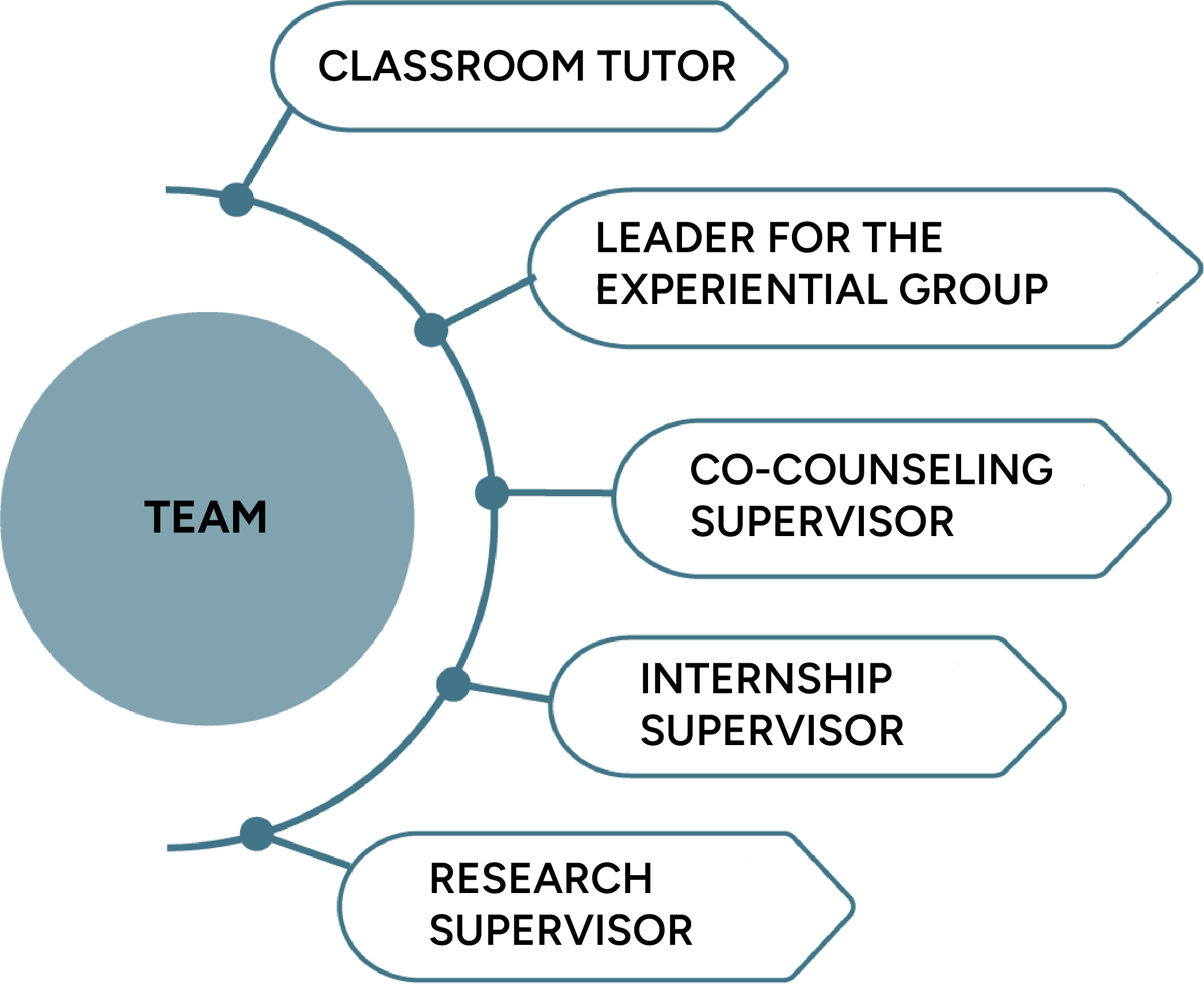
The educational program is managed by a team of Trainers of the Italian Society of Biosystemics who will follow the class throughout the 4 years of specialization. The team includes:
a classroom tutor
a leader for the experiential group
a co-counseling supervisor
an internship supervisor
a research supervisor
Training in Biosystemic Psychotherapy is designed to place great focus on the personal growth of the student through a highly experiential teaching methodology, which has always been a distinctive quality of the School.
During the 4 years, students will be guided to recognize and develop their own resources and to overcome difficulties in order to become effective and aware psychotherapists.
2. BASIC COURSES
Foundations of Psychology
The basic courses include all those theoretical and practical teachings which, in accordance with ministerial regulations, are essential to provide students with the necessary knowledge to become psychotherapists and to integrate the methods and languages of the main psychotherapeutic approaches. The different subjects are divided as follows:
- Psychodiagnostics
- Clinical Psychology
- Sexology
- Neurophysiology
- Elements of Obstetrics
- Psychodiagnostics
- Clinical Psychology
- Sexology
- Neurophysiology
- Elements of Obstetrics
- Clinical Psychology II
- Psychopathology II
- Neurophysiology II
- Immunology
- Psychiatry
- Group Theory
- Social Psychology
- Psychology of Deviance
Practical and theoretical presentation of the main psychotherapeutic approaches
- Psychoanalysis
- Cognitivism
- Perls and Gestalt Therapy
- Psychodrama
- Cognitivism
- Jungian Analysis
- Systemic-Family Therapy
- Bioenergetic Analysis
- Gestalt Therapy
3. THEORIES AND TECHNIQUES OF THE BIOSYSTEMIC THERAPY
- Existential Phenomenology: Laing, Merleau-Ponty.
- The Embryological Model: Mott, Lake, Boadella.
- Neurophysiological Foundations of the Biosystemic Model: Laborit, Gellhorn, Edelman,
- Elements of Sensorimotor Psychotherapy (Ogden).
- Deep Listening.
- Basic Session Techniques: key word, summary, reformulation, key gesture.
- Neurophysiological Foundations of the Biosystemic Model: Le Doux, Damasio, Porges, Siegel, McLean.
- Clinical Implications of Neurophysiological Dysfunctions.
- Complexity Theory (Morin).
- The Systemic Perspective: De Rosnay, Morin, Von Foerster.
- Interview Techniques: directional phrases for defining and exploring the patient’s problem at emotional and cognitive levels.
- The bodily dimension in psychotherapy: history and developments.
- Theories and studies of Infant Research.
- Bodily empathy.
- Attunement with the other at a nonverbal level, also in relation to prosody (tone and rhythm of voice).
- Techniques: directional phrases for exploring the client’s issue at the bodily level and the key gesture.
- Fundamentals of bodywork: grounding and breathing.
- Basic experiences: connection and integration.
- Creative use of objects in body psychotherapy.
- Psychocorporeal work on dreams.
- Presentation and supervision of clinical cases.
- Psychodynamic reference models: Kohut, Kernberg, Stolorow.
- Treatment techniques of the biosystemic model.
- Directional phrases at the cognitive, emotional, and bodily levels for identifying solutions to the patient’s problem.
- Metacommunication.
- The psychocorporeal approach to trauma and abuse.
- Neurophysiology applied to psychocorporeal psychotherapy (Van der Kolk, Porges).
- Working on emotions and the body in group settings: opportunities and limitations.
- Presentation and supervision of clinical cases.
- Dynamics of the therapeutic relationship (transference, countertransference).
- Transference and countertransference from a psychocorporeal perspective.
4. PRACTICAL AND EXPERIENTIAL TRAINING
Personal practical training consists in the participation to an experiential group or an individual personal therapy path with a professional chosen by the student; mutual collaboration work (co-counseling) with a partner; attendance at practical presentations of various psychotherapeutic approaches; and research activity involving the writing and presentation of an annual report.
Training in Biosystemic Psychotherapy is designed to place great focus on the personal growth of the student through a highly experiential teaching methodology, which has always been a distinctive quality of the School.
During the 4 years, students will be guided to recognize and develop their own resources and to overcome difficulties in order to become effective and aware psychotherapists.
5. INTERNSHIP
The internship is a fundamental, necessary, and legally required practical activity (see Article 8, Paragraph 2 of Regulation 509/98) for obtaining the specialization title of psychotherapist. It must be completed with a total of 150 hours per year in public or accredited private institutions.
The internship activity is an essential educational experience for putting into practice the skills acquired during the Training, learning to work within a team to collaborate with other professional figures.
Thanks to agreements with major public and private institutions across the country, students are supported in finding and selecting a suitable institution and in overcoming any difficulties encountered along the way.
Internship Coordinator and Clinical Case Supervisor: Dr. Rosanna De Sanctis.